Association of Philosophy Teachers Annual Conference 2026 - REPORT
I am sitting on a train to London as I write, feeling slightly nervous, as well as excited, about attending the fourth annual conference of the Association of Philosophy Teachers.
The last two years I have written up a report on here about how the event went. Having been one of the founding members of the APT, and organiser of the first two conferences, as well as a philosophy teacher for nearly 20 years, I have a vested interest in the success of the organisation, and last year, as I wrote on here, I was worried the APT had lost its way.
This year may well be make or break for me. A positive email from the organisation yesterday told us that the conference had sold out, which was great news to hear. I had been troubled over the last few months that so few people seemed to even know it was even happening. Besides an email, found in my junk folder, with a link to get my free ticket, there had been no other visible marketing of the event until the last few weeks. Not really enough time for working philosophy teachers to get time off and arrange cover to attend. Although they had mentioned the 2026 conference in an email sent to members in October 2025, the date given then was not the date that the conference ultimately happened. I wasn’t confident that sufficient word had got out, and as this was the fourth one of these in a row, if anything, if we were doing a good job as an organisation, attendance and knowledge about the conference should be high.
Communication — or the lack of it — has been a bit of a theme for me with the APT over the last twelve months. Ignoring the fact they seem to be the only professional organisation I am a member of whose emails routinely go to junk mail no matter what changes I make to my settings, those emails have been few and far between. The October email I mentioned was the only communication we got after the conference in 2025. (They did not send us the conference slides). It advertised an upcoming international philosophy Olympiad and a “resources competition”. Then there was nothing more until January, where we were invited to an online Teams Meeting which would cover the upcoming 2026 British Philosophy Fortnight in March, the aforementioned resources competition, and the planned official APT response to the government’s curriculum review.
The latter item was actually quite worrying to me, as the proposed response seemed to be to back down on some of the core lobbying that had been the entire point for forming the APT. I couldn’t attend the meeting due to other commitments (and the short notice!) but sent my (lengthy) thoughts for discussion to the Chair, who said they would be passed on to members. I still have no idea if they ever were (as a member I certainly did not receive an email), or what members thought about the agenda items (there has still yet to be any minutes from that meeting shared with the group). No further communication came by email from the APT until April, advertising the conference and its new date. That email also noted that the Chair and Treasurer would be stepping down at this year’s conference.
Over a month later, another email, this one with the speaker schedule for the conference (now just a month away). A few weeks after that we got a reminder email, including an acknowledgment (at last!) that emails seemed to be lost in people’s junk folders and an announcement that the resource competition would not be running “due to lack of entries”. Also an acknowledgement that the membership portal to pay to become a member on the website has not been working. So someone interested in the conference (our only recruiting tool) and thinking of joining, evidently couldn’t. Nor could we current members renew our membership. In previous years the conference fee was the membership fee. This year the conference is free, and you can’t sign up as a member, so I have no idea as I am writing this if my membership has expired or will continue following the conference. (Note: typing this up at the weekend after the conference, the link for membership still does not work).
So I sit on the train right now with low expectations. There is still little sense of a cohesive association or shared mission amongst the members and, other than the January Teams meeting which has no shared record of what was discussed, has been no professional discourse about what we want from the organisation. But I still sit hopeful that I will be proved wrong in my doubts. Maybe a rich sense of purpose will be made clear by the conference’s end? I hope that the fully booked conference will be a success and this year, unlike last, I shall come away from London feeling a sense of renewed purpose from the organisation. After all, the lineup this year looks good, despite the fact there was never a public call for papers put out to members as there was in previous years. Solid speakers and a cohesive set of talks that I guess the committee just hand-selected. Lisa Bortolotti is always great, and as a keynote speaker should send us off in the right direction for the day. Kant on animals is interesting and useful for teaching the A-level, so the fact John Callanan’s talk is the only one on offer for session one suits me just fine (though after previous years’ wealth of choices the lack of choice here does seem strange). There is choice for session two, and I shall be attending the session on Philosophy, Teaching and AI with Anja Steinbauer, Alexandra Konoplyankif, Tom Berman, and Helen Ratesvich. An interesting, timely, and potentially very useful talk given the current climate in education. I am not interested in Heidegger (and not just because of his Nazi sympathies. Strange after all these years at the APT conference previously focusing on decolonising and diversifying the subject that we now have two consecutive talks about the philosophies of white racists, Kant and Heidegger) but the competing session, run by the current Chair, is offering a talk on him for those who are. Then, after the AGM, which I hope is more than the brief set of notices last year’s was, there follows a talk from the chief examiner of AQA Philosophy, Jamie Swann, on their difficult 25 mark essays, which should be useful CPD. If I didn’t owe it to my students to go to that, I’d be just as happy seeing Jeremy Hayward’s competing talk on making safe spaces brave spaces, although I have seen Hayward’s different talks at the conference the last two years in a row.
That’s where I shall leave it now, as the train approaches Euston and the venue at UCL. Quiet hope, but that lingering doubt. I shall report back on the train home…
*****
…ok, I’m actually reflecting at a table outside a chain of Leon at Euston station after grabbing some pre-travel dinner, but I am happy to report that this year’s conference seemed like a success…ish.
The heat in London today was sweltering, so it is a testament to the speakers’ quality that we all seemed happy to spend the day in a stuffy, windowless, studio room with no air conditioning down in the basement of UCL’s Institute of Education to hear them. The iced coffee I’d grabbed on the way to the venue melted before I’d even walked a block on from the store and I regretted my decision to wear a backpack as the sweat clung beneath it, making me feel like a sticky mess as I signed in and got my delegate lanyard. But it was good to see familiar faces milling about the tea, coffee, and cakes as I entered Punnett Hall.
I’m terrible with names at the best of times, and struggle in these sorts of professional situations where you meet people again who you have seen consecutively at these things three or even four years in a row and still don’t remember who they are by name. Only a vague familiarity at the face and the general content of their character. But I did the proper thing and tried to mingle in my socially awkward way as best I could before the opening remarks.
Jeremy Hayward wins the prize for best reference of the conference and he did it in the first two minutes of housekeeping, noting how we philosophers were now all stuck in a dark subterranean cave staring happily at a PowerPoint reflecting on the wall, meanwhile fire-exits would lead us up out of the cave and out into the sun. Then Lisa Bortolotti kicked things off with an excellent talk about Epistemic Injustice and Agency. Although she applies it in her work a lot to healthcare, especially mental health, she showed how taking all people seriously as epistemic agents, including young people, has obvious application in the school. Essentially, the more we feel in control, the more we have agency. But denying people the status as a “knower” due to some prejudiced and unjust dismissal takes that agency away from them, causing them a moral harm, and all of us an epistemic harm, as their potential contributions to collective knowledge are lost.
As someone who thinks epistemic injustice is a hugely important issue and have been trying to incorporate it into my teaching for several years now (it is vital to understanding why the current Philosophy exam specification is so limited and why the philosophy canon needs expanding) I found it a really useful and informative session that gave me lots of further ideas to bring back to the classroom. Again though, for the second year in a row, I didn’t feel the talk was utilised by the conference organisers as an effective keynote. Bortolotti’s talk could have been a brilliant opening to a conference themed around epistemic injustice’s role in our profession and the need to expand the voices we listen to as philosophers, continuing the diversification and decolonisation theme. Or a conference themed around looking at old thinkers in new ways, once different voices were added to the conversation. At its simplest, were the APT to better coordinate between the various professional strands of philosophy teaching, the AQA exam board has recently sent round guidance to teachers about diversifying our teaching of the A-level they run by better including the “wartime quartet” of Midgley, Foot, Anscombe, and Murdoch. Their historic exclusion is clearly a case of epistemic injustice, and a session on that today would give a sense of cohesion and vision to the conference.
Instead of this cohesive vision, professor Bortolotti’s talk was followed by John Callanan’s session on Kant and animals. The subject is interesting, and Callanan was an engaging speaker. (Again - are we doing an epistemic injustice to animals when we exclude them from our thinking might have been a thread to connect these two non-optional talks). Lack of cohesion aside, I really enjoyed the session. Alongside the fact that it is a relevant, slightly tricky, bit of the AQA Philosophy A-level spec so always good to be walked through by an expert, Callanan’s specific focus on pedagogy as he did so made it useful even if you were familiar with the arguments he covered. Callanan talked through the thinking not only around the issue in Kant’s philosophy, but the choices he would make as a teacher in the seminar room when asking students to think about it. Essentially using the ethical tension in Kant’s conception of moral value and our intuitions about animals to encourage students to break down how their own intuitive responses to an issue might be understood if applied to everyone, and then perceived by “the other” who disagrees. His focus on common structural issues exposed in different solutions to the same question allows the topic of the moral standing of animals to act as a jumping off point for more general considerations about philosophical inquiry. Once we think about our obligations as moral agents to animals who can never be agents, only moral patients, we are led having to think if the same is true of other moral patients who can’t have moral obligations back at us, such as the environment, or artificial intelligence.
The talk was followed, appropriately, with an entirely vegetarian lunch, and a chance to leave the stuffy room for some fresh air. The fresh air turned out to be even hotter outside, but a group of us found a nice spot in the shade and ate beans, peppers, and arancini in the sun while discussing various things arising from the two talks, as well as my recent decision to eat fish again after so many years, which one of them had read about here on PU a few weeks ago.
The lunch was good, and the break from the cave was welcomed. But like Plato’s freed prisoner, we had spent enough time in the sun and it was soon time to return to the shadows.
Unfortunately, this is where the conference took a turn for me. Opting for the symposium on AI, Teaching, and Philosophy with Anja Steinbauer, Alexandra Konoplyankif, Tom Berman, and Helen Ratesvich, instead of the Chair’s talk on Heidegger, I expected some deep discussion about this potential threat to the cognitive skills so crucial for philosophy in our students, or at least some thoughtful defences of AI and ways to make it work. All we got instead, after a set up from Anja and Alexandra sort of listing various concerns about AI and also various potentials of it, were pitches from Helen and Tom, two people working in AI, who had various platforms to advertise to us as apparently brilliant tools for philosophical thinking. Sadly both platforms just seemed to me like more outsourcing of human thinking, offering various buttons we could press to simulate interrogation of our ideas and offers of different perspectives, as well as the usual summaries of existing thought, instead of allowing us to develop thinking for ourselves. But there was no real attempt to argue why this was a good or desirable thing (besides the obvious reason which justifies all AI use: it’s quicker, it’s easier, I don’t have to work for it). But this is a philosophy conference. Assumptions should be interrogated. Why is quicker better? Is this particular quickness better? Is my resistance a prejudice I need to overcome? Are AI tools something we should be exploring alongside, or instead of, traditional learning methods? It just seemed, instead, like they both thought the tools were cool because they had created them. That we should use them because we can. Because they’re there.
Later, when it finally became a Q&A and not simply an infomercial, I asked about whether they thought AI arriving at a time when our educational system is so flawed is a perfect storm that might doom the developing cognitive skills of young people? While we adults in the room might see additional functions from AI that can supplement and add-to existing cognitive skills we’ve already developed, because the current UK school system is so hyper-based around instrumentalism — learning as a means only to get grades — which encourages students to aim for the end (the grade) and not really care about the journey, is it not likely young people using these AI tools will not use them in the thoughtful ways that might be possible on paper, or in a demonstration to a room of philosophy teachers? They are far more likely to use them as a shortcut and leave behind the possibility of being able to philosophise for themselves?
The question was not really answered, and the session ended rather unsatisfactorily. Again I was thinking, would a session on AI as a potential epistemic agent have been more thematically relevant? Or a session on why AI-generated epistemic claims from our students should not be so readily dismissed by teachers as “not their work”?
Oh well. It wasn’t for me, but others in the room seemed eager to try out the two platforms we’d been shown and might have found it useful. I probably should have just gone and learned about Heidegger!
Disappointment piled on disappointment as the advertised AGM did not happen during its advertised time-slot at the tea and coffee break. That was mainly disappointing because, assuming it was happening as advertised, I opted not to go to the toilet despite having chugged water in the hot room throughout the AI chat. When the final session began, and I realised my sacrifice of personal comfort had been for nothing, I was certainly a little bit miffed. I also wondered what it meant for the APT? Without the AGM, there really would be no real mention of the APT as an organisation at the whole conference! The talks so far had been interesting and thought-provoking, and met the vague conference brief of “Sharing Ideas, Enriching Practice, and Advancing Philosophy Education”, but what was the APT? Now that we’re all here in the same room together, what are we for? What are our aims and objectives? What do members think about those aims and objectives? If the organisation is so unimportant that we can forget to do its AGM and take things seriously, why have a formal organisation at all? After all, the original APT was an ad hoc zoom meeting. We were encourage by the British Philosophical Association to create a more formal structure because of the supposed benefits it would bring for lobbying purposes and for galvanising teachers of philosophy as a collective group. If we’re not doing those things as an organisation, why bother?
If I could sum up my frustration and disillusion with the APT in the last year, it is exactly this: the sense that it is a closed shop, where decisions happen at a secret committee level, behind closed doors, and are then communicated to members without any real consultation or discussion. Because I was on the inside as part of the conference organising committees the first two years, I think I felt the organisation was far more transparent than it actually was. Maybe it even was back then? Or maybe information I thought was being shared with everyone was probably only being shared with us who were organising the conference and I didn’t notice because I was one of the lucky ones? Once I was on the outside though, as a bog-standard member, I began to see how opaque our organisation actually is. And how little it felt like “our” voice was being asked for and shared.
If the annual conference is just a collection of random talks and some food, with no intentional and specific APT focus about what we as philosophy teachers collectively want, and we also have no other APT meetings across the year (or only one, advertised at short notice), then when exactly are we philosophy teachers associating?
As those thoughts flew around my head, Jamie Swann from the AQA began his talk on the A-level’s 25 mark questions. Annoyingly, given regulations on the exam boards, he began the session by pointing out he couldn’t say anything we hadn’t already been told, as the AQA could not provide new materials to us not made public to everyone. So although the talk was a comforting assurance that I am teaching and marking the 25 mark question correctly, it added nothing new to my understanding. In fact, for a few of the questions I was able to offer answers the examiner said put it better than he could. A session on incorporating the wartime quartet into our teaching would have been far more valuable. I probably should have seen Jeremy Hayward again for the third time in a row.
But again — a conference is not just for me, it is for everyone. There is no denying that this talk on 25 mark essays was incredibly useful for people who hadn’t heard it all before, and it was, in itself, a worthy and valuable thing to have on the programme for a conference of people, many of whom teach A-level philosophy. I didn’t end the day annoyed I had heard it, and, as I said, it was good to feel validated in my approach to teaching this part of the course.
And then, miracle of miracles, before the day wrapped up, the missing AGM! A vote on new roles. Robert Penny stepping down as Chair and taking on a new role as Web Officer, the Treasurer leaving (not yet replaced), and then the vote for a new Chair.
This is where the “ish” comes in when I said the day was a success. Because it turns out only one candidate (or rather a pair of candidates as co-Chairs) had offered themselves up for the important role of leading the organisation (before you ask — I considered it, but don’t want APT to be my whole life. I want to be able to use it as a member, not run the thing. It shouldn’t be too much to ask for a functioning professional organisation to exist, and a good one should engage with the views of its membership, so any Chair would still get to hear anything I felt I could offer). I’m sure they’re very committed and intend to do well, and I don’t want to write them off without giving them a chance. I don’t know them personally at all and I am sure they’re very nice people. But Jon Donnelly and Patricia Copeland, the pair standing to be new co-Chair together, were two of the key organisers from last year’s problematic conference where, for my mind, the wheels started coming off the APT, and Jon Donnelly was specifically the guy who gave the talk I personally found most contrary to the original vision of what the APT was supposed to be. I hadn’t attended Patricia’s talk that year precisely because as “I think philosophy should be about more than “high-impact” retention and “direct instruction”, and don’t think discovery learning should be a dirty word in our profession, I knew the talk would just leave me angry.”
In other words - under the new leadership voted in during the closing minutes, I fear we may go further in last year’s wrong direction and undo any encouraging steering back on course that this year’s improved conference seemed to offer.
I also found it odd that we ended up with a “new” Committee which still looks very similar to how it looked before, with the old Chair simply moving over to a different role, and the two conference planners from last year back behind the reins. One of whom, Robert Penny described as his unofficial “deputy” anyway. As far as democracy goes, it all felt very performative and showy rather than a genuine election from an organisation that takes itself seriously. A public show of hands to vote them in. No proper counting of votes. No request for nos or any abstentions. Just an assumption that one candidate offered and it was a done deal. In fact the only mention of any process for replacing the current team before the election was being asked to email Robert if you had any interest in the roles. We knew the vote would happen at the AGM, but there was no further pushing for people to put themselves forward, or deadlines for applications given. Nor even instructions on what to submit if you were thinking about it. Compared to the BPA, who had their own elections earlier this year, and encouraged candidates repeatedly to step forward before the vote was held (electronically and formally) it felt very much like a caricature of democracy rather than anything real. After all, the lack of other candidates could be perceived as a testament to how poorly the APT has been run by the old team and how detached the membership feel, and yet we appear to have re-voted in the exact same team?
As any classroom teacher knows, dissent in a public show of hands in front of the very people you are voting for is very hard to do. Peer pressure works. I know this because looking around the room each time and seeing that mine was the only hand down, I felt churlish not voting. Yes — I myself voted for the only choices on offer. But only because I hand’t been given the chance to vote against or abstain. Robert was doing the website anyway, it felt somehow wrong not to let him continue given no one else was standing, even though this is the website which doesn’t actually work currently if you want to be a member. But when I kept my hand down when the vote for Chair took place I felt petty so sheepishly raised it in the end. After all — maybe I’m the only one who feels this way? Maybe the other members absolutely adored last year and wish for more? It’s not my conference and not my association, it’s for all of us, and all of us can be catered for. But I do wonder what the membership vote really means when at no point in the last few years has there ever been any serious discussion about what we want the APT to be and if it is doing it or not?
Again — I want to give the new team a chance. I can’t assume anything until they actually start to run the thing. For all I know they share the same frustrations that I do and are going to do great things. Time will tell. I might just be unfairly judging them on some talks that weren’t to my taste last year. Again, as with today’s conference, I hope to be proved wrong. But it felt like a step in the wrong direction for the Association not to have a proper discussion, debate, or any real talk across the whole day about who we are and what we stand for, irregardless of any elections. The elections just cemented the fact that I don’t really know if we’re all on the same page when we talk about the importance of promoting philosophy. Ultimately, I shouldn’t have to write these thoughts on my own personal blog if lines of communication were available to express them within the organisation. Hopefully, under the new leadership team, communication might get better?
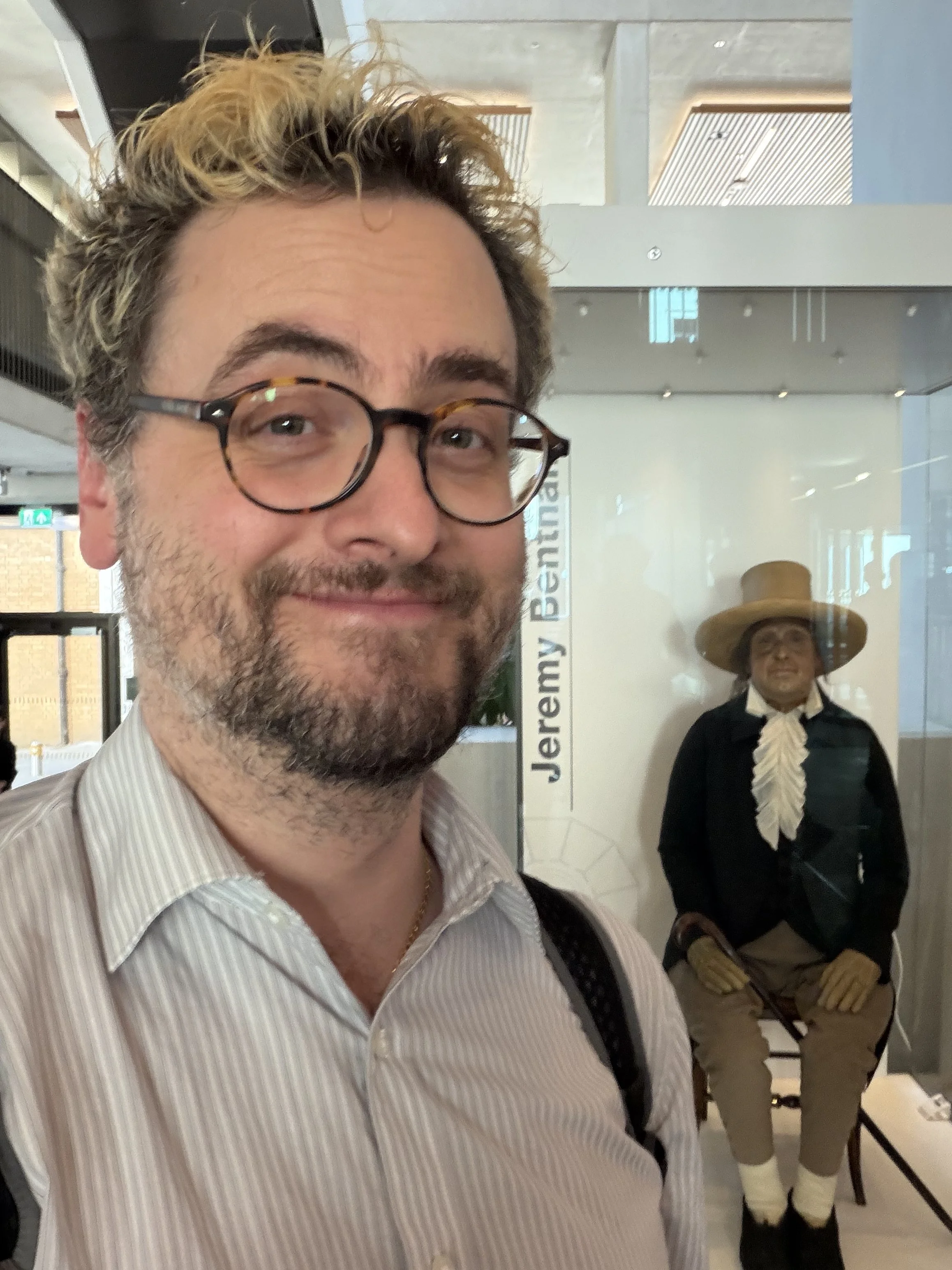
Those gripes aside, on balance, it was a lovely day, and did leave me feeling invigorated and inspired. I shall be applying several new things I thought about today into the classroom and speaking to other members across the day was good. A lot of them are interested in the new GCSE-equivalent philosophy course I have devised at my school, and I hope to talk to members about it at the conference next year when we have seen our first cohort through. My quibbles are not with the conference, but with the running of the APT in general and my sense that it lacks a point or might have lost its way. Ultimately, it’s always nice to meet up with fellow people in your profession, especially for those who work alone (as is often the case in Philosophy). I felt broadly positive as I left the Hall, and what better way to end a day of philosophy talk than with Jeremy Hayward taking us on a quick trip up to see Bentham’s body encased in his plastic tomb and pay homage to the father of utilitarianism. Ultimately it’s about maximising happiness for the most amount of people, and the majority of people at this year’s APT conference (including me) seemed to enjoy it. Hopefully it will be onwards and upwards for 2027.
Author: DaN McKee (he/him)
If you liked this post and have enjoyed what I do here at Philosophy Unleashed - and have been doing every year since 2019 - and want to buy me a coffee or cool philosophy book as a gift to say thank you, feel free to send a small donation/tip my way here.
My book, ANARCHIST ATHEIST PUNK ROCK TEACHER, is out everywhere on paperback and eBook. You can order it direct from the publisher or from places like Amazon. Paperback or e-book. I also have a short horror story in the new anthology, HARDCORE HORROR, also available to buy from Earth Island.
My other book - AUTHENTIC DEMOCRACY: An Ethical Justification of Anarchism - is available HERE , from the publisher, and from all good booksellers, either in paperback or as an e-Book. I also have a chapter in THIS BOOK on punk and anarchism.
Listen to me on The Independent Teacher podcast here. Read my Anarchist Studies journal paper on Anarchism and Character Education here. My paper - ‘An error of punishment defences in the context of schooling’ - is in the Journal of Philosophy of Education (behind an annoying paywall!) here. Listen to me on the Philosophy Gets Schooled podcast here. Listen to me talk anarchism and wrestling here or anarchism and education here.
For everything else DaN McKee related: www.everythingdanmckee.com