In Memory of Dermot O’Keeffe (1958 - 2026)
In 1998, I left my uninspiring secondary school for Sixth Form College so I could study Philosophy. That’s when I first met Dermot O’Keeffe, the teacher who changed my life. The friend I’ve had now for over twenty-five years since leaving that college in the year 2000. A friend who sadly died last Saturday after a lengthy co-existence with cancer.
I refuse to say “courageous battle” with cancer, although Dermot was certainly courageous in his acceptance of the disease, as well as proactive in his fight against it. I say “co-existence with” instead because, since his first diagnosis, although he went to great lengths to stave off the inevitable, including hard and risky surgery, Dermot was always so inspiringly stoic about the whole thing: it’s happened, it’s not great, I’ll do what I can to push back, but let’s do all the living that we can while we can and not let it ruin things too much. His courageous battle was with life, not with the cancer. The cancer could go fuck itself. “Life is not a battle or a race or a competition”, Dermot told me in one of his recent emails. “Avoid such metaphors. Life is life, and not some other thing.”
Another friend who was with me in Dermot’s philosophy class back in ’98 put it this way when I told him Dermot’s health was deteriorating: “we didn’t know it at the time, but he was exactly what we wanted to find when we rocked up to college looking to have our philosophical worlds rocked”. And he is so right. At that point in my educational journey I just knew that I wanted something that wasn’t school, but I didn’t know what that something might look like. Turns out it looked like Dermot, All of a sudden those annoying questions the two of us always used to ask at school, which got us into so much trouble, had now found their audience. If anything, Dermot’s questions were even more annoying and challenging than our own, making us think in ways we’d never thought before and introducing us to whole histories of norm-upending ideas.
Suddenly, after years of hating it, I was now enjoying being in a classroom again. An average student at best before taking up philosophy, Dermot’s lessons made me want to read way beyond what we needed to know for our course because Dermot himself was so clearly well-read. Ideas and interesting stories oozed from him. To assist in his students’ intellectual journeys, he would always be happy to lend you a book or recommend something you might like if he didn’t have a copy himself. I had come to Sixth Form a disaffected student, angry at God and wanting to use philosophy only to finally disprove the supposed existence of the ridiculous divine, but Dermot’s passion for the subject showed me there were far more interesting things to think about in philosophy than theology (ethics, for example, and politics), and that theology itself was not as simple as being pro, or anti, the idea of God. The rational was wonderful, he taught us, but there could be beauty in the irrational too.
Dermot was the first teacher I ever saw myself in. I loved the adult way he treated us. As with all teachers at that particular college, he allowed us to call him by his first name instead of Mr O’Keeffe. But he also expected us to do the reading ourselves so we could discuss our thoughts together next lesson and not waste precious time in the same room staring dully at individual copies of the text. He would ask us what we think, not what we thought he wanted us to think. And he would introduce us to films and art as well as philosophy, showing that philosophy enriches, it doesn’t replace, other forms of thought and expression. Best of all, for a historically “naughty” student like me, he negotiated with us as equals when it came to any behavioural issues (such as the time I insisted on jokingly calling philosopher G.E. Moore Patrick Moore for a whole term every time he was mentioned which, Dermot explained to me, had caused several of my peers to mistakenly name the astrologer rather than the ethicist in their last assessment. Or the time he asked my friend and me to not try to answer every question so that other people in the class would actually have a chance to speak). Tellings off which felt humane and educational rather than punitive or coercive. My behaviour actually improved instead of what had happened previously at school, where stupid enforcement of petty rules always felt like an invitation to break them further.
And then there were the “kick about” lessons where we were free to discuss whatever we wanted, so long as we made it philosophical. Sometimes these discussions ended up in the pub afterwards, Dermot smoking at a few cigars (it was a different time) as we all nursed our lemonades and cokes and debated the finer points of some unsettled debate. The website I have run since 2019, Philosophy Unleashed, was, and is, entirely inspired by those “kick about” lessons because it was first inspired by lessons I have run myself ever since becoming a teacher trying to give my own students that same thrill of a Dermot “kick about”.
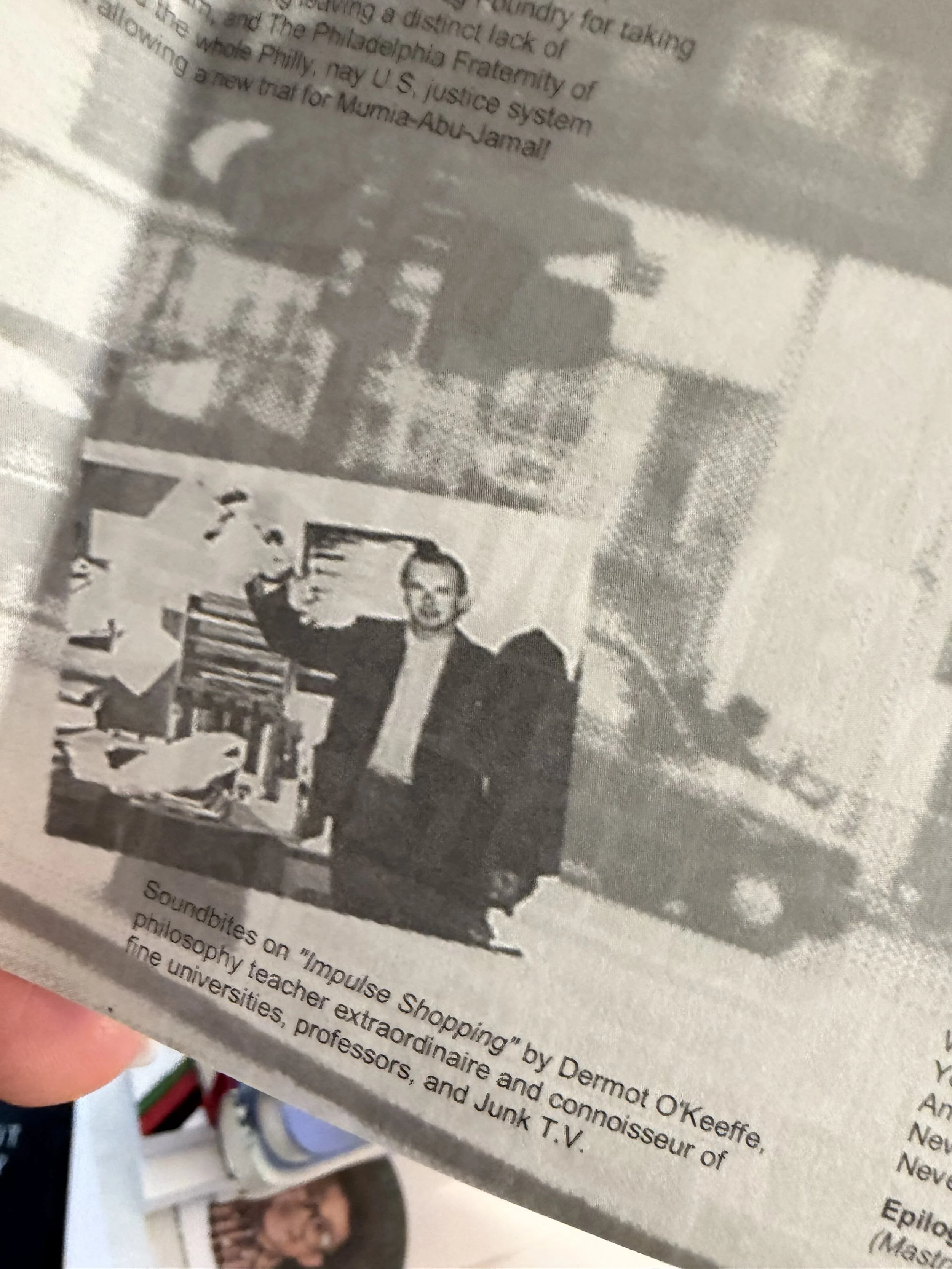
I’m burying the lead. Forget the website; I became a teacher myself because of those “kick about” lessons. How could Dermot not be our favourite teacher when he even agreed to write and record a few short spoken word clips for a song on the 7” punk ep our teenage band was recording? “Everything was fine until Marx met Spencer” and “Man is born free, but everywhere he is in chain stores”. We even included a photo of him for the inlay.
Eventually, Sixth Form ended, but Dermot kept in touch with a few of us as we all went our separate ways across the country to study Philosophy at university. When my friends and I popped back to the Midlands to see friends and family during breaks from studying, we’d be sure to organise a catch up with Derm and continue one of our “kick abouts” at a mutually convenient pub or cafe. More cigars for Dermot and, for me, a lifelong non-drinker, more lemonades. Although I’ve never smoked, for a while I used to keep all my guitar plectrums in one of Dermot’s old discarded Cafe Creme tins salvaged after one of these, always stimulating, sessions.
Sometimes, we would go to his house to chat over a meal, meeting his wife and children along the way, feeling welcomed into his family’s home. An insight into philosophy as lived practice. Discussions about books and politics, theology and mind, epistemology and ethics. Art, television, and the meaning of life. I would always go back to university invigorated in ways that few of my academic lectures ever made me feel. As I continued my studies — MA, then PhD — Dermot always kept an interest. We continued our regular chats even as others lost touch across the years. I added a wife of my own to mix and he welcomed her warmly. Eventually, having rejected a career in academia and not really knowing what I wanted to do with my life besides a vague idea about teaching, I went to him, as I often did, for advice.
“How do you become a teacher?”
He told me how his daughter had trained with something called a “consortium” and expressed all the ways he thought I’d make a great teacher. I googled the word as soon as I got home, along with the phrase “teacher training” and found a place nearby. Filled in the application. Got a phone-call soon after and, within a month, was on a training programme ready to start at a school in September. Life forever changed by Dermot again.
Days before my first term was due to begin, my dad died. Unexpected, world-shaking. I foolishly decided to carry on with the teacher training anyway. Dermot understood. Again that stoic wisdom: death will come for us all eventually. Don’t let it put off your living. Good advice as it turned out. My mother died a few years later. Que será será.
As I trained in Dermot’s profession, I’d share my observations with him and he’d give me the advice of experience: focus on the teaching, not all the non-teaching stuff; listen to your students more than some of your colleagues (you’ll know the ones); good philosophy lessons can be found everywhere — the right single sentence or line of poetry can be the stimulus for a whole hour’s discussion if you use it right; enjoy the holidays when they come and read a lot; take a walk. All advice I still follow to this day.
Over the next sixteen years we continued to meet regularly, sharing resources and ideas as well as gripes and groans about the profession and the world. Sharing book and TV suggestions, as well as funny stories and personal updates about our lives. Grandchildren, nephews and nieces, holidays to beautiful places, the latest headaches…. At some point quite early in all that, Dermot retired early after my old college decided to drop Philosophy from its curriculum in a fit of short-sighted perniciousness. He was glad to be out. The place was crushing his soul. He wrote poetry, painted, went on long walks and holidays, and no longer had to mark a single tedious essay or sit through another dull staff meeting. I was jealous. I wished I could retire too! But as happened to me when I did eventually step away from teaching briefly in 2022, the bug had bitten Dermot too deep to ignore forever. Retirement? Be careful what you wish for. There are always more bills to pay. Dermot returned to teaching again.
Bizarrely, as an experienced Head of Department now myself, I was one of his references. I even found I had a few things I could help him with after some changes in the exam specifications while he was away. It was nice to be able to pay back his own professional kindness and generosity with something helpful of my own. We became peers as well as friends.
The world got worse though, no matter how much we tried putting it to rights over coffee. The austerity years of consecutive Tory governments and the butchering of education by Michael Gove. Continued environmental self-harm. Racist rhetoric. When Brexit came it was a kick in the teeth. Trump kicked us both again while we were down. Twice. And Covid brought its own challenges even as it forced us to take our chat away from pubs and coffeehouses and into the fresh air of local National Trust locations. But we tried leaning towards dark humour when everything got too much rather than the bleakness of utter nihilism. There was always something to laugh about and, through that laughter, find hope.
Our conversations weren’t always verbal. Dermot wrote essays and poems too. We’d often swap essays and poems. Swap notes and encouragements. When I wrote my first book, he was one of its first readers. When he wrote his, I read it the day it came out. Emails were common — a link here, a rogue thought shared there. Outrages and new reasons to cheer. In the last few years, when his health issues started emerging, Dermot got more reflective. He sent me stories of his past, his history, more stray thoughts in the middle of the night.
A month before he died, he sent a flurry. He knew what was coming from the titles of the missives he attached: Ignorance; Desiderata; My Education; and, most tellingly, Final Poem.
Dermot was teaching right until the end. From Ignorance: “The future isn’t adumbrated, or sketched even lightly, by the authority of the past. The future has never existed. Never. Only past futures. Never future ones. We have no data whatsoever on tomorrow.” From Desiderata: “We can’t directly control our beliefs, but we can invite reason to their birth, baptism and confirmation. Develop your beliefs deliberately and responsibly. Don’t be afraid to change your mind. Your beliefs aren’t you. You don’t need to have a view on everything. Tread lightly.” From My Education: “What I learnt at school was of small account compared to what I learnt at home, in the village library, and from my part-time jobs…The hardest but most important thing to reflect on about my education is both what I wasn’t taught, and what I failed to learn…I was practically deterred from studying history by the clever stratagem of being taught it. ” And then there was his Final Poem, which was simply a list of words in one column paired with their conceptual opposite in another. A reminder that picking a single lane will lead only to the most impoverished life. Be open to everything. Certainty is the death of understanding.
We were supposed to meet for a final coffee together on May 19th. However, a sudden decline in health just as I was set to meet him changed plans rapidly. “I’m in bed and full of morphine.” He explained later that day in an email. “Less fun than it sounds.” And with the explanation a cartoon he’d drawn “in the middle of an especially awful night.” One which, he promised, “helped.”
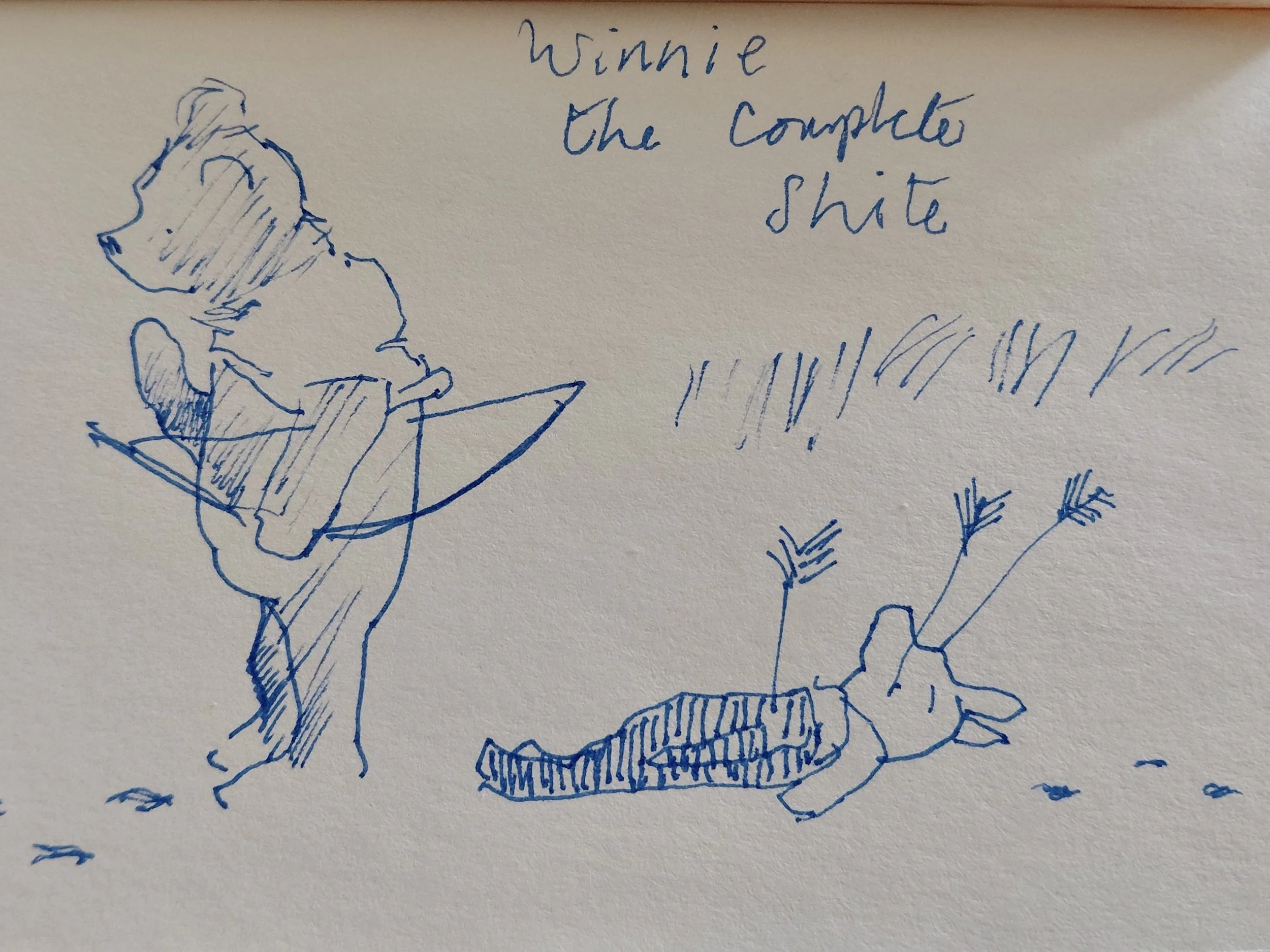
We had rescheduled the coffee for three weeks later, though he did warn me in that last email “I can’t plan anything with full confidence which is annoying! I’ll be remembered as a slacker.”
Sadly, the coffee never happened. I got an email from his wife warning me that he was entering palliative care a few days before. By the following Saturday, he was gone.
Gone, but never to be forgotten. A singular teacher, thinker, friend, artist, writer, humorist, and human being, Dermot was a cornerstone of what made me who I am, and the loss of him will be deeply felt by anyone who was lucky enough to have known him over his too-brief life. I am just one of the many students he changed the lives of over the years and I know many more who will hear the news of his passing will feel as devastated as I do today. But as I said to his daughter when she told me the news, those of us who knew Dermot enough to be saddened by the loss of him will, through our having known him, undoubtedly have been given the very tools we need to make, and remake, sense of the whole thing.
It is one of the great unfairnesses of death that often the person you most want to talk to about the loss is the very person that you are missing. I’ve certainly felt this week like I need to sit in a pub garden somewhere in Warwickshire and speak to my old philosophy teacher about how unfair this whole thing is. Get his well-considered take just one last time in the always welcome warmth of a long June evening. Find something to laugh about to take the sting away.
Looking through his recent emails though, I see that in that instinct to find something to smile about, Dermot’s influence lives on; his take is already known: “Laugh if you can. (It’s often a choice.)” he says in Desiderata. “Choose joy over dismay and cynicism.”
And so, happily, in this time of extreme grief, I will do just that. Instead of wallowing in the cynicism of what I have lost, I shall take joy and comfort in what I, and all of us who knew Dermot, have had. After all, although my friend is dead — my brilliant, philosophical, friend for whom the most profound insights and well-articulated wisdom always seemed to come so easily and whose gentle guidance across the decades changed my life in multiple ways — and we shall never have one of those chats together again, the unfairness of the whole situation was perfectly summed up in the final email he sent me, in what he did not necessarily know would be, at the time (at least from my perspective), his last words: “Winnie the complete shite”.
As last words go, they’re not bad.
And they will forevermore bring a smile to my face,
even through the tears.